Irish Soda Bread with Guinness, Walnuts and Raisins
- Prep
- 15 min
- Cook
- 42 min
- Yield
- 1 loaf (12 slices)
- Level
- medium
- Cuisine
- Irish-American
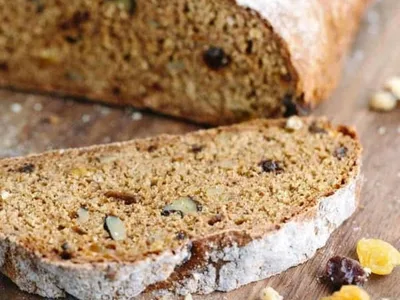
A hearty, rustic Irish soda bread enriched with Guinness stout and Greek yogurt for subtle depth and tender crumb. Dark brown sugar and toasted walnuts add complexity, while plump raisins provide bursts of sweetness throughout. Unlike traditional soda breads, the beer and yogurt create a moister, more forgiving dough that stays fresh longer. This version bridges classic Irish baking with modern ingredients for better texture and flavor. Perfect for breakfast with butter and jam, afternoon tea, or alongside soups and stews. The scoring creates beautiful crust breaks, while the mix of warm spices and fruit makes each slice satisfying. Ideal for home bakers seeking a rustic loaf that impresses without requiring yeast or long rising times.
No ratings yet — be the first
Ingredients
Method
8 steps- 1
Preheat oven to 400°F.
- 2
Combine spelt flour, dark brown sugar, baking soda and kosher salt in a large mixing bowl.
- 3
Add Greek yogurt, Guinness stout, walnuts and raisins. Stir until dough comes together into a ball. If too wet, add flour one tablespoon at a time until slightly sticky but shapeable.
- 4
Turn dough onto a well-floured surface and knead into a rough ball for about 1 to 2 minutes.
- 5
Shape into a 12-inch long by 4-inch wide loaf and transfer to a parchment-lined sheet tray.
- 6
Sprinkle dough with flour and use a sharp knife to score 4 diagonal lines across the surface.
- 7
Bake for about 40 to 45 minutes until the loaf sounds hollow when tapped or internal temperature reaches 176°F.
- 8
Cool for 10 minutes, then transfer to a wire cooling rack or serve warm.
Tips
For deeper bread flavor, let dough rest 15 minutes after mixing. This hydrates the flour fully and develops gluten structure naturally, resulting in better crumb definition and easier scoring without tearing.
Don't overwork the dough. Irish soda bread relies on baking soda for lift, not gluten development. Mix until just combined; overworking creates tough, dense texture. Slight lumpiness is fine.
Tap the bottom of the loaf to test doneness. A hollow sound indicates the interior has cooked through. For extra assurance, check internal temperature with a thermometer—it ensures the center is fully baked without overbrowning the crust.
Good to Know
Wrap cooled bread in plastic wrap or store in an airtight container at room temperature for up to 3 days. Toast day-old slices to refresh.
Dough can be mixed and shaped up to 4 hours ahead, covered loosely, and baked when ready. Do not refrigerate; baking soda loses potency over time.
Serve warm or at room temperature with butter, jam, honey, or smoked salmon. Pairs well with soups, stews, and cheese.
Common Mistakes
Do not skip the scoring step to avoid cracks forming randomly during baking and compromising presentation.
Do not overbake to avoid excessive browning and dry interior; rely on the hollow-tap test and temperature.
Do not use self-rising flour to avoid excessive rising and a cake-like texture from extra leavening agents.
Substitutions
Dairy-Free Swaps
Gluten-Free Swaps
Nut-Free Alternatives
removes bitterness, adds subtle nuttiness without allergen
Full guide →General Alternatives
similar body and roasted notes, slightly different flavor profile
removes beer entirely; brew strong, cool to room temp
FAQ
Can I make this bread without Guinness beer?
Yes. Substitute strong black tea, dark ale, or a non-alcoholic stout for identical texture and similar roasted flavor. Brew strong, cool completely, and measure the same volume. The bread will be slightly less bitter but equally moist.
How long does Irish soda bread keep after baking?
Wrapped tightly at room temperature, it stays fresh for 3 days. Beyond that, texture becomes dry. Slice and freeze for up to one month; thaw at room temperature or toast from frozen. Day-old slices taste better toasted.
Can I freeze this soda bread?
Yes. Cool completely, wrap in plastic wrap and foil, and freeze for up to one month. Thaw at room temperature for 2-3 hours or toast slices directly from frozen. Do not refrigerate; it stales faster in cold.