Lacto-Fermented Coconut Oatmeal Granola Clusters
- Prep
- 15 min
- Yield
- 4 servings
- Level
- medium
- Cuisine
- Global
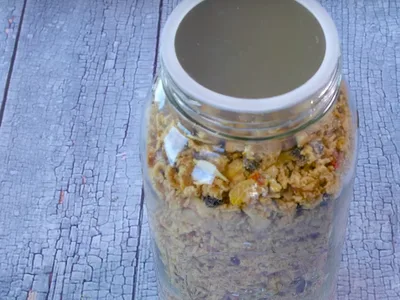
Creamy kefir and coconut water transform rolled oats, dried fruit, and warm spices into a tangy, probiotic granola that ferments for 2-4 days before low-temperature dehydration into crunchy clusters. Whole fat kefir and heavy cream provide richness while goji berries, apricots, and banana chips add natural sweetness and chew. Serve as breakfast cereal with yogurt or milk, over smoothie bowls, or as a snack. This version prioritizes gut health through active fermentation rather than baking, creating a living-culture granola with complex flavor development.
No ratings yet — be the first
Ingredients
- 4 cup old fashioned rolled oats
- ¾ cup unsweetened coconut flakes
- ¾ cup dried apricots, chopped
- ¼ cup raisins
- ¼ cup banana chipsdried pineapple1:1citrus variant
- ¼ cup goji berries
- ¾ cup chopped nuts, raw or roasted, unsalted
- ½ teaspoon sea salt
- 1 teaspoon ground cinnamon
- ¼ teaspoon ground nutmeg
- ¼ teaspoon ground cardamom
- 1 cup coconut water
- 1 ¼ cup whole fat kefirgreek yogurt1:1dairyadds dairy
less probiotic activity, slightly thicker ferment
- ¼ cup raw honey
- ½ cup coconut oil
- ½ cup heavy cream
- 1 teaspoon vanilla extract
Method
12 steps- 1
Combine oats, coconut flakes, dried apricots, raisins, banana chips, goji berries, and chopped nuts in a large bowl and mix well.
- 2
Stir in sea salt, cinnamon, nutmeg, and cardamom until evenly distributed.
- 3
Whisk together coconut water, kefir, honey, coconut oil, heavy cream, and vanilla extract in a medium bowl.
- 4
Pour wet mixture into dry ingredients and fold with a spatula until fully combined.
- 5
Transfer to a half-gallon mason jar, pressing gently to compact but leaving space at the shoulder for expansion.
- 6
Place fermentation device on jar without deploying weight mechanism, secure with wide-mouth ring, and fill moat halfway with water.
- 7
Leave on kitchen counter to ferment 2-4 days (or 24-46 hours if room is warm) until noticeably tangy.
- 8
Transfer fermented mixture to a large bowl and stir to recombine.
- 9
Scoop 1/2 to 3/4 inch balls onto dehydrator trays lined with solid plastic sheets or parchment, spacing 1/2 inch apart.
- 10
Dehydrate at 145F for one hour, then break clusters apart for air circulation.
- 11
Reduce heat to 125F and continue dehydrating until completely dry, up to 24 hours total.
- 12
Cool and transfer to an airtight half-gallon jar for storage.
Tips
Fermentation time varies by room temperature and kefir strength. Begin tasting at 48 hours; stop when you detect pleasant tang and slight sourness.
Do not deploy the weight mechanism during fermentation to allow gases to escape naturally; water moat prevents mold while maintaining anaerobic conditions.
Break clusters after the first hour of dehydration to ensure even drying and prevent dense centers that may harbor moisture.
Good to Know
Transfer cooled granola to airtight half-gallon jar. Refrigerate for up to one month. Fermentation provides natural preservation; monitor for any off odors before consuming.
Ferment up to 4 days in advance. Dehydrate clusters 3-5 days ahead; store airtight at room temperature until ready to serve.
Serve as breakfast cereal with milk or yogurt, over smoothie bowls, or as a snack with nut butter. Clusters soften slightly over time; reheat 2-3 minutes in a 300F oven if crispness is desired.
Common Mistakes
Overfill the jar above the shoulder to avoid overflow during fermentation expansion.
Deploy the weight mechanism during fermentation to allow gases to escape and prevent jar pressure buildup.
Skip the mid-point cluster break to avoid dense, incompletely dried centers that trap moisture and spoil.
Substitutions
Dairy-Free Swaps
2
Vegan Options
General Alternatives
FAQ
Can I ferment this granola without a Kraut Source device?
Yes. Use any wide-mouth mason jar with a standard lid, loosely tightened to allow gas escape, or wrap cloth over opening and secure with rubber band. Burp the jar daily by opening briefly to release pressure.
What if my dehydrator has only one temperature setting?
Start at 125F and extend total time to 30-36 hours. Check clusters after 20 hours; some may finish earlier depending on individual dehydrator performance. Alternatively, begin at 145F for 90 minutes, then continue at lowest available heat.
How long can I keep this granola after dehydration?
Refrigerated in an airtight jar, 3-4 weeks. At room temperature in airtight storage, 10-14 days (fermented products are more perishable than baked granola). Freeze for up to 3 months in freezer-safe container; thaw at room temp before opening to prevent condensation.