No-Knead French Bread with Long Cold Ferment
- Prep
- 15 min
- Cook
- 22 min
- Yield
- 2 servings
- Level
- medium
- Cuisine
- French
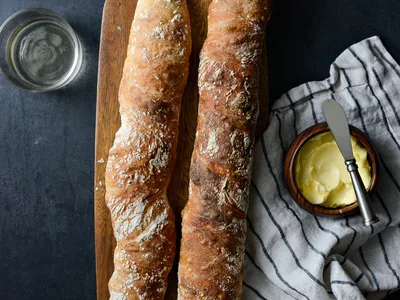
Rustic French-style baguettes made with minimal yeast and extended cold fermentation for deep flavor and open crumb. The dough requires just a stir, overnight rest, and a quick shaping before baking. Steam from ice creates a crispy, golden crust while the interior stays tender and airy. Perfect for serving warm with butter or alongside soup, salad, or cheese. This method proves that great bread needs time, not kneading.
No ratings yet — be the first
Ingredients
- 3 cup artisan bread flour, plus more for dusting
- ½ teaspoon kosher salt
- ¼ teaspoon active dry yeast
- 1 ⅞ cup waterwhole wheat flour blendsubstitute 1/2 cup water with 1/2 cup whole wheat flour for nuttier flavor, extend fermentation to 18-24 hoursconf: 3
adds:gluten
Full guide →
Method
11 steps- 1
Combine flour, salt, and yeast in a large bowl and stir.
- 2
Pour in water and use a rubber spatula to mix thoroughly until all flour is hydrated.
- 3
Cover bowl with plastic wrap and ferment on the counter for 10 to 24 hours.
- 4
Generously flour a clean work surface. Scrape dough onto surface with a rubber spatula and divide in half with a bench scraper or knife.
- 5
Stretch first piece into a baguette shape. Using floured fingers, grab from underneath, pull up and pinch along the entire length. Repeat 3 to 4 times to build tension.
- 6
Place on parchment paper or greased baking sheet. Reshape and tuck sides with your fingers to form a firm loaf.
- 7
Repeat shaping with second piece. Make slits on top if desired and let rest 20 to 30 minutes.
- 8
Preheat oven to 425°F. Place a metal skillet on the bottom rack. Once hot, add 2 cups of ice to the skillet.
- 9
Slide first loaf into oven and bake 18 to 22 minutes until deeply golden.
- 10
Remove and allow oven to return to temperature. Add fresh ice and bake second loaf the same way.
- 11
Cool slightly until safe to handle, then slice and serve.
Tips
Extended fermentation develops complex flavor. Don't rush the 10-24 hour rest; cooler temperatures (65-70°F) yield better results than warm kitchens.
Steam is essential for crust. Ensure the oven is fully preheated and ice hits the hot pan immediately for maximum steam generation.
Tension shaping creates an open crumb structure. The pinching and tucking steps build surface tension that supports oven spring.
Good to Know
Wrap completely cooled loaves in paper and store at room temperature for 1 day. For longer storage, wrap in foil and freeze up to 3 months. Thaw overnight at room temperature.
Complete fermentation up to 24 hours in advance. Shape and refrigerate for up to 8 hours before the final 20-30 minute rise and bake. Cold dough bakes beautifully and may need 1-2 extra minutes.
Slice warm or at room temperature. Serve with salted butter, olive oil, or alongside soup, salad, cheese, and cured meats. Tear by hand for informal settings.
Common Mistakes
Use insufficient steam to avoid dense, pale crust with no oven spring; ice must contact hot pan immediately.
Skip the folding and pinching steps to avoid flat loaves; tension shaping is essential for rise.
Ferment in a warm kitchen (above 75°F) to avoid over-proofing; cooler temps near 65-70°F are ideal.
Bake second loaf without preheating the oven to avoid underbaked interior; allow temperature to fully recover between loaves.
Substitutions
Gluten-Free Swaps
conf: 4
Full guide →General Alternatives
adds:gluten
Full guide →FAQ
Can I use all-purpose flour instead of bread flour?
Yes, all-purpose works but yields softer loaves with less chew. Bread flour develops stronger gluten and creates a chewier crumb. If substituting, the dough may need slightly less water since all-purpose absorbs less.
What if my kitchen is warmer than 75 degrees?
Fermentation will accelerate. Check dough after 8-12 hours instead of the full 24. You want a bubbly, risen dough with some slack; over-fermented dough becomes sticky and difficult to shape.
How long can I keep baked loaves?
Store completely cooled, wrapped loaves at room temperature for up to 1 day. For freezing, wrap in foil and store up to 3 months. Thaw unwrapped overnight at room temperature or refresh in a 350°F oven for 10 minutes.