Pan de Cristal: Crispy Glass Bread with Open Crumb
- Prep
- 30 min
- Cook
- 30 min
- Yield
- 1 loaf (4 slices)
- Level
- medium
- Cuisine
- Spanish
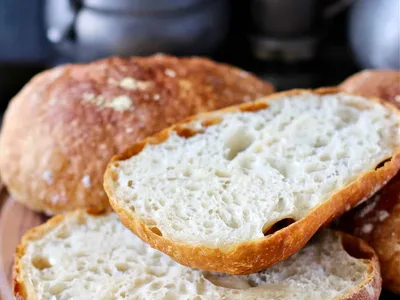
Pan de Cristal is an airy, open-crumbed Spanish bread with a thin, shattering crust that resembles glass. This high-hydration dough relies on extended folding and long, slow fermentation to develop structure and create the characteristic large irregular holes. The method emphasizes proper dough temperature management and steam injection for crust development. Serve warm with olive oil for dipping, alongside cheese and cured meats, or use for sandwiches where the crispy exterior and tender interior shine. This version prioritizes hand-folding technique over bulk fermentation, creating distinctive cascading folds within the loaf that contribute to the dramatic crumb structure.
No ratings yet — be the first
Ingredients
- 2 cups water, room temperature
- 4 cups strong bread flour, preferably King Arthurall-purpose flour0.95bakes
note: slightly less structure; extend folding time by 1-2 folds per session
- ⅛ oz instant yeast, active dry or instant
- ⅓ oz table salt, flaked sea salt acceptablekosher salt1.25bakes
flakes are less dense; weigh if possible to maintain salt percentage
- 1 tbsp olive oil, for pan and folding
Method
16 steps- 1
Mix water, flour, yeast, and salt by hand or with dough whisk in a medium bowl.
- 2
Oil a 7x10 inch or 9 inch square casserole dish with olive oil and pour in dough.
- 3
Check dough temperature; it should reach 72F. If cooler, move to a warmer location.
- 4
Cover and rest for 20 minutes.
- 5
Fold dough from outside toward center all around the pan, performing 8-12 folds until dough shows some strength. Cover and rest 20 minutes.
- 6
With wet or oiled hands, lift dough from the middle and let drooped ends cascade back into pan in folds. Turn pan and repeat. Continue folding until dough strengthens. Cover and rest 20 minutes.
- 7
Repeat the fold and rest sequence three more times, with an 80-minute rise after the final coil fold.
- 8
Invert pan onto heavily floured surface and turn dough out without deflating.
- 9
Using a bench scraper, cut dough into four pieces and transfer each to parchment paper. Dust generously with flour.
- 10
Let loaves rest uncovered for two hours.
- 11
Meanwhile, preheat oven to 475F with baking stone on center rack and steam pan on bottom rack.
- 12
Transfer two loaves on parchment to pizza stone using pizza peel.
- 13
Add one cup ice cubes to steam pan and bake for 15 minutes.
- 14
Open oven to release steam, remove parchment, and bake 15 minutes more.
- 15
Repeat with remaining two loaves.
- 16
Cool loaves on a wire rack.
Tips
Dough temperature is critical: aim for 72F after mixing. In warm weather, use cooler water (85F); in cold weather, use warmer water (105F) to compensate for ambient conditions.
The coil fold is the signature technique. Lift from the middle like a folded towel, letting ends drape into the pan. This creates distinctive cascading folds that become the dramatic crumb structure.
Two-hour final rest is essential. This long bulk fermentation at room temperature allows the dough to fully proof and develop the open, irregular crumb characteristic of pan de cristal.
Good to Know
Wrap cooled bread tightly in plastic wrap or store in an airtight container at room temperature for up to two days. Pan de cristal is best consumed within 24 hours when the crust is crispiest.
Dough can be prepared through the first fold session, then covered and refrigerated for up to 12 hours. Return to room temperature and continue folding sequence before the two-hour final rest.
Serve warm or at room temperature. Tear apart and accompany with olive oil for dipping, pairing with Spanish cured meats, aged cheese, and tomato-rubbed bread. Excellent for tartines or standalone as a centerpiece bread course.
Common Mistakes
Do not skip temperature checks to avoid dense, slowly-rising dough.
Do not deflate dough when turning out onto floured surface to avoid losing gas structure and achieving a closed crumb.
Do not omit the steam injection step to avoid a tough, non-crackling crust.
Do not rush the two-hour final proof to avoid underdeveloped, compact loaves.
Substitutions
note: slightly less structure; extend folding time by 1-2 folds per session
flakes are less dense; weigh if possible to maintain salt percentage
Full guide →FAQ
Can I make this dough in a stand mixer instead of by hand?
Yes. Mix on low speed for 3-4 minutes until ingredients combine, then perform all folding steps by hand in the oiled pan as directed. The folding stages cannot be replaced by machine mixing and are essential for proper crumb development.
What if my dough temperature is below 72F after mixing?
Move the pan to a warmer spot, such as a turned-off oven with the light on, a proofing box, or near a heating vent. Check temperature every 10 minutes until it reaches the target. Temperature directly affects fermentation speed and final crumb structure.
How long can I keep baked pan de cristal and can I freeze it?
Store cooled bread in an airtight container for two days at room temperature. Freeze wrapped loaves for up to one month. Thaw at room temperature for 2-3 hours, then crisp the crust briefly in a 200F oven for 5-10 minutes to restore the glass-like exterior.