Reverse Seared Duck Breasts with Honey Mustard
- Prep
- 15 min
- Cook
- 45 min
- Yield
- 4 servings
- Level
- medium
- Cuisine
- American steakhouse
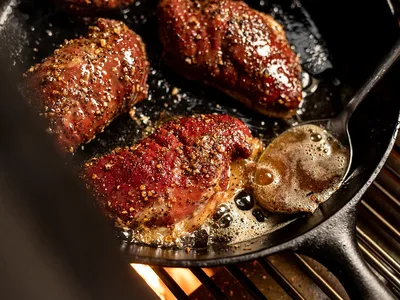
Reverse searing is a precision technique that delivers perfectly cooked duck: low-temperature smoking renders fat while keeping meat tender and juicy, then a high-heat sear creates crackling skin. This version combines applewood smoke with a salty-sweet honey mustard sauce spiked with pickled mustard seeds and hot sauce for complexity. The method eliminates guesswork—you hit your exact target doneness (125°F) every time. Duck breasts have rich, savory meat that pairs beautifully with bright, tangy condiments. This is restaurant-quality cooking for home kitchens with pellet grills. Serve to impress guests who appreciate technique and bold flavors. The reverse sear transforms what many home cooks fear (rubbery duck) into something sophisticated and accessible. This approach differs from traditional pan-searing by separating the gentle cook from the aggressive crust, ensuring neither overcooks.
No ratings yet — be the first
Ingredients
- 4 duck breasts, boneless, skin onChicken breasts1:1poultry
chicken cooks faster; reduce smoke time to 30-40 minutes and final sear to 3-5 minutes; target 165°F internal temp
- Cattleman's Grill Roadhouse Beef and Steak Seasoning
- 1 tbsp Kozlik's Triple Crunch Pickled Mustard SeedsWhole grain mustard1:1condiment
loses texture contrast but adds similar tangy flavor
- 1 tbsp Kozlik's Dijon Classique Mustard
- 1 tbsp Reida Farm Kansas Wildflower Honeymaple syrup or agave1:1sweetener
shifts flavor profile slightly; maple adds earthiness, agave is more neutral
Full guide → - 1 tbsp Duke's mayonnaisestandard mayonnaise1:1condiment
Duke's has higher yolk content; standard mayo is thinner and less rich
- 1 tsp Heat Maverick's Anti Gravity Hot Sauce
Method
15 steps- 1
Preheat pellet grill to 150°F in smoking mode.
- 2
Season duck breasts with beef and steak seasoning.
- 3
Place breasts skin side down on second shelf and smoke for one hour.
- 4
While smoking, whisk together pickled mustard seeds, Dijon mustard, honey, mayonnaise, and hot sauce. Refrigerate until serving.
- 5
Remove breasts from grill and adjust grill by removing second shelf and diffuser door.
- 6
Increase grill temperature to 600°F.
- 7
Score the skin of duck breasts with a knife.
- 8
Place breasts skin side down in cast iron skillet and set directly over flame.
- 9
As fat renders, baste breasts with spoonfuls of duck fat and tilt skillet to coat from above.
- 10
Cook until internal temperature reaches 125°F, about ten minutes.
- 11
Flip breasts to meat side and cook for less than one minute.
- 12
Remove to a plate and cover to rest.
- 13
Pour off all but a few tablespoons of duck fat from skillet.
- 14
Add vegetables to skillet and roast until softened, stirring occasionally.
- 15
Slice duck breasts and serve over roasted vegetables with honey mustard sauce drizzled over.
Tips
Score duck skin in a crosshatch pattern without cutting into meat. This increases surface area for fat rendering and helps achieve crispy, crackling skin while the interior cooks gently through reverse searing.
Basting with rendered duck fat during high-heat searing cooks the top of the breast evenly without overcooking the thinner edges. Tilt the skillet slightly to pool fat for efficient basting.
Let duck rest five to ten minutes after cooking. Resting allows carryover cooking to finish the center while fibers relax, ensuring juicy slices instead of a dry, crumbly texture.
Good to Know
Cooked duck keeps refrigerated in airtight container for three days. Honey mustard sauce keeps refrigerated for one week. Reheat duck gently in low oven to prevent drying.
Prepare honey mustard sauce up to one day ahead. Smoke duck breasts up to eight hours ahead, then finish searing before serving for best skin crispness.
Serve over roasted root vegetables, wilted greens, or creamy polenta. Pairs with light red wines like Pinot Noir or full-bodied whites like Chardonnay.
Common Mistakes
Skip scoring the skin to avoid dense, chewy skin that fails to crisp during high-heat searing.
Don't rush the smoking phase or increase temperature prematurely to avoid underrendered fat and tough, mealy duck meat.
Don't overcook past 125°F internal temp to avoid dry meat; carryover cooking will carry it to medium.
Substitutions
loses texture contrast but adds similar tangy flavor
shifts flavor profile slightly; maple adds earthiness, agave is more neutral
Full guide →chicken cooks faster; reduce smoke time to 30-40 minutes and final sear to 3-5 minutes; target 165°F internal temp
Full guide →Duke's has higher yolk content; standard mayo is thinner and less rich
FAQ
Can I make this without a pellet grill?
You need precise low-heat smoking capability. Use a charcoal smoker set to 150°F or an offset smoker with good temperature control. Skip smoking entirely and pan-sear from start to finish, but you lose the smoke flavor and must manage timing more carefully.
What if I don't have duck breasts?
Chicken breasts work as a substitute but cook faster. Reduce smoke time to 30-40 minutes and sear time to 3-5 minutes, targeting 165°F internal temp instead. Pork chops or thick steak are also options; adjust times based on thickness.
How long does reverse seared duck keep?
Cooked duck stores refrigerated in an airtight container for three days. Reheat gently in a low oven at 275°F for five to ten minutes to avoid drying out. Freezing is possible for up to two months but may affect texture slightly.