Rosemary Sea Salt Focaccia with Two Rises
- Prep
- 20 min
- Cook
- 20 min
- Yield
- 12 servings
- Level
- medium
- Cuisine
- Italian
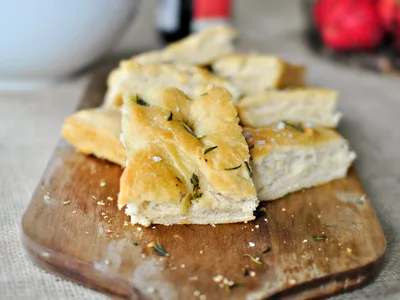
Pillowy focaccia with a crispy, dimpled crust and herbaceous rosemary finish. Warm water activates the yeast for a two-stage rise that develops subtle flavor and tender crumb. The high oven start followed by temperature reduction creates golden-brown edges while keeping the interior soft. Serve warm as an appetizer, side to soups and salads, or tear apart for sandwiches. This version balances whole wheat nutrition with bread flour structure, avoiding the overly dense texture that whole grain focaccia can develop.
No ratings yet — be the first
Ingredients
- 1 cup warm water, about 110 degrees
- 1 teaspoon honey
- 2 ¼ teaspoons active dry yeastinstant yeastsame weight, slightly faster risebakingvegan
note: reduces rise time by 10-15 minutes
Full guide → - 2 cups unbleached bread flour
- ⅝ cup white whole wheat flour
- 1 teaspoon kosher salt
- 2 tablespoons olive oil, plus more for bowl, pan and drizzling
- 1 ½ tablespoons fresh rosemary, chopped leavesdried rosemaryuse 2 teaspoons dried, crumble finelybakingvegan
dried is more potent; sprinkle before second rise
Full guide → - 2 pinch flaked sea salt
Method
16 steps- 1
Combine warm water and honey in a measuring cup. Sprinkle yeast over top and let sit 5-10 minutes until foamy.
- 2
Mix flours and kosher salt in mixer with dough hook attachment.
- 3
Pour yeast mixture into dry ingredients and blend until coming together.
- 4
Add olive oil and continue mixing until a ball forms.
- 5
Transfer dough to oiled bowl, coat with oil, cover with towel, and let rise in warm place for 2 hours.
- 6
Oil a quarter sheet pan generously.
- 7
Punch down dough gently and stretch to fit the pan, rustically forming if needed.
- 8
Cover with towel and let rise 30-40 minutes.
- 9
Preheat oven to 450 degrees.
- 10
Once risen, sprinkle rosemary over dough.
- 11
Make dimples across surface with your fingers spaced a couple inches apart.
- 12
Drizzle olive oil into dimples until pooling.
- 13
Sprinkle flaked sea salt over top.
- 14
Bake at 450 degrees, then immediately reduce to 375 degrees for 18-20 minutes until golden brown.
- 15
Cool 5 minutes in pan. Loosen edges with offset spatula if sticking.
- 16
Cut into squares and serve warm.
Tips
Water temperature is crucial: 110-120 degrees activates yeast without killing it. Use a thermometer for accuracy rather than guessing by feel.
The dimples should be generous and deep. Oil pools in them during baking, creating pockets of crispy, oil-rich texture that define focaccia.
If your kitchen is cool, extend rise times by 15-30 minutes. Dough rises by volume and spring, not elapsed time.
Good to Know
Cool completely, then wrap tightly in foil or food-grade bag at room temperature for up to 2 days. Reheat at 350 degrees for 5-8 minutes to restore crispness.
Dough can bulk ferment in refrigerator 8-16 hours after first rise. Punch down, shape, cover, and refrigerate. Let come to room temperature (about 1 hour) before second rise and baking. Alternatively, shape into pan, refrigerate overnight, then bake from cold (add 5-8 minutes to bake time).
Warm from oven, torn into pieces or cut into squares. Serve alongside Italian soups (minestrone, pasta e fagioli), as a side to grilled vegetables, or with cured meats and cheeses. Also works as a vehicle for dipping in good olive oil mixed with herbs.
Common Mistakes
Use water below 105 degrees or above 120 degrees to avoid killing yeast or slow fermentation.
Skip the second rise to avoid dense, gummy interior that lacks focaccia's characteristic crumb.
Omit dimples to avoid flat, cake-like texture instead of the signature pillowy structure with crispy pockets.
Use too little oil in pan and on top to avoid dry bread and loss of characteristic richness.
Substitutions
Vegan Options
note: reduces rise time by 10-15 minutes
Full guide →dried is more potent; sprinkle before second rise
Full guide →General Alternatives
result is less complex flavor and softer crumb
FAQ
Can I make this without a stand mixer?
Yes. Combine yeast mixture and flours in a large bowl, stir vigorously by hand for 2-3 minutes, then knead in the oil. Hand-kneading will take 8-10 minutes to develop enough gluten. The result is equally good if slightly more labor-intensive.
What if my dough doesn't rise enough in 2 hours?
Rise time depends on room temperature. In cool kitchens (under 68 degrees), dough may need 2.5-3 hours. Proof is roughly doubling in volume and light, airy feel, not clock time. Extend second rise if needed.
How long can I keep focaccia and can I freeze it?
At room temperature, 2 days well-wrapped. Freeze baked focaccia up to 3 months in airtight container. Reheat from frozen at 350 degrees for 10-12 minutes. Do not freeze unbaked shaped dough; texture becomes unpredictable.